About 106 minutes
The Merman and the Figure-Head — Themes and Context
Folklore
24,298 recorded words. 4 minutes difference from this book's estimate.
View Gutenberg source #53901
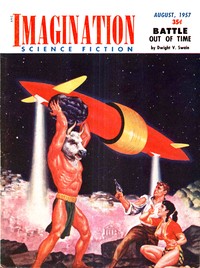
The source record for Battle Out of Time — Background and Themes measures this digital text at 25,143 words, 1 hr 50 min estimated reading time, and 3 detected text sections.
The text analysis averages about 12.6 words per sentence, while the detected sections provide another way to judge how the source is divided.
Project Gutenberg metadata also associates the work with “Science fiction,” connecting these edition facts with the source record’s subject description.
Explore this collection
These alternatives are selected using recorded categories and estimated reading time.
About 106 minutes
Folklore
24,298 recorded words. 4 minutes difference from this book's estimate.
View Gutenberg source #53901About 120 minutes
Folklore
27,466 recorded words. 10 minutes difference from this book's estimate.
View Gutenberg source #57380About 134 minutes
Folklore
30,718 recorded words. 24 minutes difference from this book's estimate.
View Gutenberg source #64134Search stored excerpts and compare books → Choose by your preferences →
Choices use stored catalog measurements. Estimates vary with reading speed. A shared category is a catalog label, not a claim that two books have the same argument or literary quality.
Search reads excerpt text stored with this catalog and links to its associated Gutenberg record. The connection is stored in the site database; this tool does not recheck that every excerpt is word-for-word identical to that external record. Excerpt search does not cover every chapter and does not verify historical publication dates.
Catalog snapshot checked: 2026-09-25. Coverage: 91 public books, 91 available source excerpts.
Read the complete public-domain text at its original source.
Read on Project GutenbergDwight V. Swain opens Battle Out of Time with a protagonist who is acutely aware of his anachronism. Dion Burke, a modern man thrust into Bronze Age Crete, carries a Smith & Wesson revolver and thinks in terms of archaeology—noting that the lustral area matches Sir Arthur Evans's speculations. Swain's diction oscillates between pulp adventure and a more reflective interiority, as when Burke observes the play of lamplight on frescoed octopi and finds his own mind 'claimed' by the weirdness of the realm. This tension between the familiar and the alien drives the narrative's voice.
Swain crafts Burke's internal monologue with a blend of hardboiled terseness and archaeological precision. Phrases like 'death yet bayed at his heels' sit alongside references to the Queen's Megaron and lustral areas. Burke's dialogue with Ariadne reveals his irritation at being mistaken for Dionysus: 'For the hundredth time, girl: I'm not Dionysus, not a god. I'm Dion Burke, that's all.' This insistence on his modern identity, even as he plays along with the god-claim, creates a layered voice. The author also uses physical details—the 'worn Smith & Wesson' and the 'biting, acrid smell' of the oracle's vapors—to ground the fantastical in the tangible.
Dialogue in the excerpts serves as a battlefield of assertion and deception. King Minos's speech is marked by imperatives and threats: 'How do you choose to die?' and 'Make way to the shrine, that the oracle himself may judge this mocker!' Burke counters with cool bravado, twisting Minos's accusation into a claim of godhood. The exchange is rapid, with Swain using short lines and interruptions to heighten tension. Ariadne's halting, uncertain words contrast with Burke's irritation, highlighting her isolation. Notably, the dialogue often carries subtext—Burke's laughter is 'without mirth,' and his smile is 'thin, wry'—indicating a gap between spoken words and inner calculation.
Swain's descriptive passages rely on sensory details to evoke the Cretan palace. The opening paragraph establishes 'an utter dark' with 'clouds drawn heavy' and wind that makes lamps flare 'orange and yellow.' The frescoed octopi seem to writhe in the flickering light, a detail that blurs the line between decoration and menace. Later, the throne-room is described with 'carved gypsum throne' and the lustral area as a 'stone-walled well' with 'broad steps leading down.' The author uses these settings to reflect Burke's psychological state: the shaking knees and nervousness before the oracle pit mirror the reader's sense of impending danger. The 'biting, acrid smell' of vapors adds a visceral layer to the supernatural.
The excerpts reveal a structure that alternates between action and reflection. Swain uses short paragraphs and fragmented sentences during moments of crisis—'But to dare the Labyrinth, the Minotaur....'—while longer, more descriptive passages occur when Burke observes his surroundings. The narrative moves from the private quarters to the throne-room to the lustral area, each shift escalating the stakes. The author also employs internal monologue to slow pacing, as when Burke wonders about Ariadne's motives or the nature of the oracle. This rhythm creates a sense of mounting tension, with the protagonist's wits pitted against both human and supernatural threats.
Readers attentive to Swain's craft will note how he uses the collision of modern and ancient to generate both humor and dread. Burke's reliance on a revolver and his archaeological knowledge are not mere props but tools for navigating a world where myth is literal. The author's choice to keep the Minotaur offstage in these excerpts—referenced only as 'the other'—builds anticipation. As you read, consider how Swain balances the demands of pulp adventure with a more nuanced exploration of identity and belief.
That rainy afternoon, Swain’s obsession with Knossos felt familiar—the way a borrowed mask can weigh on you. I kept thinking how stories reshape us, like old myths redrawn for modern hands. Later, tidying the shelf, my fingers landed on a worn copy of More Jataka Tales — Reading Companion, and I sat down again, quietly, the rain still falling outside.
Capture what you thought, learned, and would like to remember.









