About 363 minutes
Custom and Myth — Context and Discussion
Folklore
83,456 recorded words. 25 minutes difference from this book's estimate.
View Gutenberg source #14080
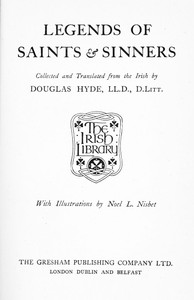
This digital edition of Legends of Saints & Sinners. Collected and Translated from the Irish — Inside the Classic is described by source-level measurements including 89,043 words, 6 hr 28 min estimated reading time, and 11 detected text sections.
The text analysis averages about 21.6 words per sentence, while the detected sections provide another way to judge how the source is divided.
Project Gutenberg metadata also associates the work with “Tales -- Ireland,” connecting these edition facts with the source record’s subject description.
Explore this collection
These alternatives are selected using recorded categories and estimated reading time.
About 363 minutes
Folklore
83,456 recorded words. 25 minutes difference from this book's estimate.
View Gutenberg source #14080About 353 minutes
Folklore
81,135 recorded words. 35 minutes difference from this book's estimate.
View Gutenberg source #40290About 351 minutes
Folklore
80,541 recorded words. 37 minutes difference from this book's estimate.
View Gutenberg source #22248Search stored excerpts and compare books → Choose by your preferences →
Choices use stored catalog measurements. Estimates vary with reading speed. A shared category is a catalog label, not a claim that two books have the same argument or literary quality.
Search reads excerpt text stored with this catalog and links to its associated Gutenberg record. The connection is stored in the site database; this tool does not recheck that every excerpt is word-for-word identical to that external record. Excerpt search does not cover every chapter and does not verify historical publication dates.
Catalog snapshot checked: 2026-09-25. Coverage: 91 public books, 91 available source excerpts.
Read the complete public-domain text at its original source.
Read on Project GutenbergDouglas Hyde's Legends of Saints & Sinners presents a series of Irish folk narratives that oscillate between the sacred and the profane, often within a single tale. The collection's structure moves fluidly from hagiographic accounts—such as St. Patrick's confrontation with the pagan figure Crom Dubh—to comic anecdotes about tinkers, priests, and ghosts. Hyde's translations preserve the oral cadence of the original Irish, with repetitions, direct address to listeners, and sudden shifts in tone. The stories frequently hinge on a test or a bargain: a saint proves his power, a sinner seeks redemption, or a clever trickster outwits authority. This editorial note examines how the work's arrangement, recurring images, and movement between scenes create a distinctive reading experience.
Many tales in the collection are structured around a journey or a crossing—between land and water, the living and the dead, or the human and the divine. In “The Farmer’s Son and the Bishop,” the protagonist travels by boat to an island for ordination, and the narrative lingers on the beach, the curach, and the “broad-wombed, long-timbered boat” that carries him. The bishop leads the youth “to the brink and very margin of the lake” for a private examination, a liminal space that mirrors the threshold between lay and clerical life. Similarly, “Teig O’Kane and the Corpse” follows a man forced to carry a dead body across a river, a literal crossing that becomes a moral reckoning. These repeated boundary-crossings reinforce the collection’s concern with transition and transformation.
Physical punishment recurs as a motif of spiritual instruction. In “The Farmer’s Son and the Bishop,” the bishop beats the youth with a “thick-butted apple-knotted cudgel” until “his blood and inwards ran down to the very ground.” The farmer, watching from across the lake, interprets the beating as a necessary part of taking “the religious yoke.” This blend of brutality and piety appears elsewhere: in “The Priest who went to do Penance,” a hermit endures harsh trials, and in “The Student who left College,” a scholar faces mockery and hardship. The stories do not shy away from depicting the body as a site of suffering and learning. The imagery of sticks, blows, and bloodshed ties the spiritual journey to physical ordeal, a pattern that recurs across the collection.
Hyde’s translations retain markers of oral storytelling: direct addresses to the listener, as in “And now Archy, the story which does not concern a smotàn (?) is good, for it is you that the application of this story concerns”; formulaic openings and closings; and parenthetical asides that acknowledge the translator’s uncertainty (“the ‘Shouting Attendant’ (?)”). The language is often colloquial and rhythmic, with lists of epithets (“loutish, big-biting, lumpish (?), dawdling (?), raw-nosed (?), great-sleeping spalpeens”) that mimic the storyteller’s accumulation of detail. These features remind the reader that the text is a transcription of a spoken performance, not a polished literary artifact. The occasional question mark in brackets signals Hyde’s own hesitation, preserving the provisional nature of the translation.
Hyde’s introduction states that the stories are “either entirely founded upon Christian conceptions, or else are so far coloured by them, that they could never have been told—at least in their present shape—had not Christianity established itself in Ireland.” Yet the narratives often retain pre-Christian elements: the figure of Crom Dubh, a pagan deity; the appearance of a “great worm” in the Shannon; and the keening of the Three Marys, which echoes older lament traditions. Saints perform miracles that resemble the feats of ancient heroes, and sinners are redeemed through bargains or trials that recall folk-tale logic. The collection thus presents a syncretic worldview where holy water and fairy curses coexist, and where the line between saint and sinner is permeable.
Readers approaching Legends of Saints & Sinners should attend to the stories’ oral texture and their willingness to mix reverence with irreverence. Hyde’s translations are not smoothed into literary English; they retain the roughness of the original tellings, including untranslated Irish words and uncertain glosses. The collection rewards those who read aloud, savoring the rhythms and repetitions. It is less a unified work than a gathering of voices, each with its own logic and local detail.
Reading Hyde’s saints and their stubborn, earthy trials, I kept thinking of the household omens I once jotted down from another old volume. Both feel like whispered conversations across a kitchen hearth—signs read in a thrown stone or a sudden crow. That quiet book, Omens and Superstitions of Southern India — Reading Notes, holds the same patient weight of belief, waiting to be remembered.
Use these questions to collect your thoughts before moving on.









