About 358 minutes
English Fairy Tales — Story, Setting & Ideas
Fairy Tales
82,286 recorded words. 6 minutes difference from this book's estimate.
View Gutenberg source #17034
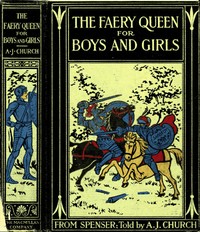
For The Faery Queen and Her Knights: Stories Retold from Edmund Spenser — Themes and Context, the stored edition analysis reports 83,578 words, 6 hr 4 min estimated reading time, and 10 detected text sections.
The text analysis averages about 23.2 words per sentence, while the detected sections provide another way to judge how the source is divided.
Project Gutenberg metadata also associates the work with “Fairy tales,” connecting these edition facts with the source record’s subject description.
Explore this collection
These alternatives are selected using recorded categories and estimated reading time.
About 358 minutes
Fairy Tales
82,286 recorded words. 6 minutes difference from this book's estimate.
View Gutenberg source #17034About 355 minutes
Fairy Tales
81,475 recorded words. 9 minutes difference from this book's estimate.
View Gutenberg source #5242About 336 minutes
Fairy Tales
77,210 recorded words. 28 minutes difference from this book's estimate.
View Gutenberg source #5243Search stored excerpts and compare books → Choose by your preferences →
Choices use stored catalog measurements. Estimates vary with reading speed. A shared category is a catalog label, not a claim that two books have the same argument or literary quality.
Search reads excerpt text stored with this catalog and links to its associated Gutenberg record. The connection is stored in the site database; this tool does not recheck that every excerpt is word-for-word identical to that external record. Excerpt search does not cover every chapter and does not verify historical publication dates.
Catalog snapshot checked: 2026-09-25. Coverage: 91 public books, 91 available source excerpts.
Read the complete public-domain text at its original source.
Read on Project GutenbergThe Faery Queen and Her Knights opens with a knight riding across a plain, his silver shield bearing dints that witness past battles. Church’s retelling preserves Spenser’s episodic structure, moving from one adventure to the next with a focus on action and dialogue. The narrative voice is direct, often using phrases like “once upon a time” to frame each quest. Recurring images—armor, shields, and spears—anchor the physical world, while characters like Archimage and Bragadocchio introduce deception through disguise and false bravado. The story of Bragadocchio, who boasts of slaying seven knights but flees at the mention of Prince Arthur’s flaming sword, exemplifies how Church uses humor and irony to undercut pride. The text’s movement between scenes is swift, with little description of landscape; instead, the setting is implied through action, such as a knight charging across a plain or a man hiding on a bank.
Church organizes the narrative into discrete chapters, each centered on a knight’s quest or a moral trial. The Red-Cross Knight’s journey to slay a dragon, Sir Guyon’s encounter with the Lady Medina, and Britomart’s search for Artegall all follow a similar pattern: departure, encounter with a deceptive figure, and a test of virtue. This structure allows readers to follow individual storylines without needing to recall the entire epic. Recurring elements—such as the false knight Bragadocchio, who appears in multiple chapters—create continuity. Church often signals transitions with phrases like “Now it came to pass” or “Meanwhile,” keeping the pace brisk. The episodic nature means that each chapter can stand alone, but together they build a cumulative picture of chivalric ideals and their subversion.
Physical objects carry symbolic weight throughout the retelling. The Red-Cross Knight’s shield is described as having “great dints upon it, which were as a witness of” past battles, linking martial history to moral character. Bragadocchio’s lack of a sword becomes a plot point: he boasts of never using one unless it is Prince Arthur’s flaming blade, but when Archimage offers to fetch it, he flees. Church uses armor to reveal character—the sham knight’s “ready tongue” is his only weapon, while genuine knights rely on proven steel. The description of combat is terse: “he smote his steed upon the flank, and set his spear in rest and charged.” This economy of language keeps the action immediate, while the repeated focus on weapons and shields reinforces the idea that knighthood is both a physical and moral condition.
Many chapters hinge on characters who are not what they seem. Archimage, the enchanter, appears in multiple guises, and Bragadocchio pretends to be a knight. Church highlights the gap between appearance and reality through dialogue: Bragadocchio’s boasts are undercut by his cowardice, and Trompart, whose name “means deceiver,” serves as his squire. The text often uses direct speech to expose hypocrisy, as when Bragadocchio cries, “Old man, you dote,” only to flee moments later. This pattern of deception extends to the false Florimell and the knight Sanglier, whose crimes are revealed through trial. Church does not moralize explicitly; instead, the narrative lets actions speak. The repeated unmasking of frauds creates a rhythm of exposure, suggesting that truth will eventually surface, though not always through direct combat.
Church’s retelling moves rapidly between settings, often with minimal transition. A knight may be “riding across the plain” in one sentence and arriving at a castle in the next. The House of Pride, the Cave of Despair, and the Bower of Bliss are introduced as locations where moral tests occur, but their physical description is sparse. Instead, the focus is on the encounter: who the knight meets, what is said, and what challenge arises. This technique keeps the narrative centered on action and dialogue rather than atmosphere. The forest appears frequently as a place of danger or refuge, as when Una meets the satyrs. Church uses verbs of motion—“rode,” “fled,” “wandered”—to maintain momentum. The result is a story that feels like a series of linked episodes, each propelling the reader forward without lingering on landscape.
Church’s retelling offers a streamlined entry into Spenser’s allegorical world, but readers should note that the original poem’s intricate symbolism is often simplified or omitted. The focus on action and dialogue makes the book suitable for younger audiences, though adults may find the moral lessons too overt. To appreciate the text, pay attention to how Church handles deception: the false knights and enchanters are not just villains but mirrors of the heroes’ own potential flaws. The swift scene changes and recurring objects—shields, swords, and disguises—create a coherent pattern that rewards close reading.
There’s a particular ache in watching knights mistake disguise for truth, armor for honor—Spenser’s deceptions echo oddly in Wilde’s pomegranate garden, where beauty hides its own sharp edges. I find myself returning to both, not for answers, but for that quiet recognition of how we all wear something borrowed. A House of Pomegranates — Background and Themes stays with me the same way—a half-remembered dream that shifts each visit.
A brief reflection can help important ideas stay with you longer.









