About 63 minutes
Indian Legends of Vancouver Island — A Closer Reading
Folklore
14,370 recorded words. 0 minutes difference from this book's estimate.
View Gutenberg source #9459
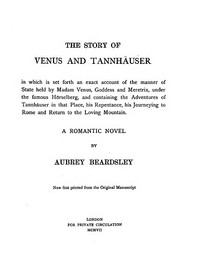
Before opening The Story of Venus and Tannhäuser: A Romantic Novel — Story, Setting & Ideas, the edition data offers a quick orientation: 14,416 words, 1 hr 3 min estimated reading time, and 2 detected text sections.
The text analysis averages about 25.4 words per sentence, while the detected sections provide another way to judge how the source is divided.
Project Gutenberg metadata also associates the work with “Fantasy fiction,” connecting these edition facts with the source record’s subject description.
Explore this collection
These alternatives are selected using recorded categories and estimated reading time.
About 63 minutes
Folklore
14,370 recorded words. 0 minutes difference from this book's estimate.
View Gutenberg source #9459About 67 minutes
Folklore
15,249 recorded words. 4 minutes difference from this book's estimate.
View Gutenberg source #62514About 68 minutes
Folklore
15,464 recorded words. 5 minutes difference from this book's estimate.
View Gutenberg source #7518Search stored excerpts and compare books → Choose by your preferences →
Choices use stored catalog measurements. Estimates vary with reading speed. A shared category is a catalog label, not a claim that two books have the same argument or literary quality.
Search reads excerpt text stored with this catalog and links to its associated Gutenberg record. The connection is stored in the site database; this tool does not recheck that every excerpt is word-for-word identical to that external record. Excerpt search does not cover every chapter and does not verify historical publication dates.
Catalog snapshot checked: 2026-09-25. Coverage: 91 public books, 91 available source excerpts.
Read the complete public-domain text at its original source.
Read on Project GutenbergThe novel opens with a mock-heroic dedication to a fictional cardinal, Giulio Poldo Pezzoli, whose inflated titles parody ecclesiastical patronage. Beardsley immediately signals his ironic stance: he calls himself a 'scrivener and limner of worldly things.' The table of contents lists ten chapters with titles like 'How Venus was Coiffed and Prepared for Supper,' promising a focus on ritualized beauty and sensual detail rather than moral drama. The foreword notes that only a portion was previously printed as 'Under the Hill,' and that this complete transcript is issued for 'literary students' due to 'the freedom of several passages.' This framing prepares the reader for a work that is both scholarly and scandalous, a hybrid of medieval legend and Decadent aestheticism.
The dedication to Cardinal Pezzoli is a masterclass in ironic flattery. Beardsley addresses him as 'Most Eminent and Reverend Prince' and laments that 'the writing of epistles dedicatory has fallen into disuse.' The cardinal's supposed titles—'Nuncio to the Holy See in Nicaragua and Patagonia'—are absurdly specific, hinting at a world where religious authority is a costume. The foreword further distances the work from conventional morality, claiming it is for 'those literary students who are also admirers of Beardsley's wayward genius.' This double audience—the scholar and the connoisseur of the forbidden—shapes the entire narrative. The epigraph from the Roman de la Rose, 'La chaleur du brandon Venus,' links the novel to medieval allegory while subverting its moral intent.
The excerpt describing Venus's boudoir reveals Beardsley's method: the space is a cabinet of curiosities, filled with 'tiny wax statuettes,' 'quaint magots that looked as cruel as foreign gods,' and 'clocks that said nothing.' The room is a self-contained world of artifice, where nature is replaced by 'Claudian landscapes' on folding screens. Venus herself is described as a work of art: 'those who have only seen Venus at the Louvre or the British Museum... can have not the faintest idea how sweet and enticing and gracious' she appears. The narrative dwells on textures—'rose silk,' 'soft cushions,' 'transparent' chemise—and on the meticulous disordering of Cosmé's coiffure. This emphasis on crafted beauty over natural virtue sets the tone for the entire work.
Beardsley undercuts the traditional romance by making Tannhäuser a deliberately unheroic figure. After a sexual encounter, the narrator remarks: 'It is, I know, the custom of all romancers to paint heroes who can give a lady proof of their valliance at least twenty times a night. Now Tannhäuser had no such Gargantuan facility.' This deflation of expectation is typical of the novel's humor. Tannhäuser is 'rather relieved' when others interrupt, and he finds the actor Lesfesses 'quite uninteresting off the stage.' The scene ends with Venus being carried to bed 'in a nice, motherly way' by the manicure Priapusa. The medieval legend of sin and repentance is replaced by a comedy of manners, where desire is both indulged and gently mocked.
Beardsley's prose is as ornate as the interiors he describes. Sentences are long, piled with clauses and exotic vocabulary: 'the beautiful tétons du derrière were as firm as a plump virgin's cheek, and promised a joy as profound as the mystery of the Rue Vendôme.' The narrator shifts between mock-heroic elevation and colloquial asides, creating a tone of knowing sophistication. The use of French phrases ('tétons du derrière,' 'L'Eau Lavante') and allusions to contemporary figures (Mr. Theodore Watts) anchors the fantasy in a specific cultural milieu. The novel's structure—ten chapters with elaborate titles—mimics the formality of a medieval romance while its content subverts it. Readers should attend to the rhythm of the sentences, which often carry the meaning as much as the events.
The excerpts reveal a work that is less a narrative than a series of decorative tableaux. Beardsley's Venusberg is a realm of aesthetic pleasure where morality is irrelevant. Readers will find the plot secondary to the style; the pleasure lies in the language itself. Approach the novel as you would a cabinet of curiosities: examine each detail, savor the irony, and do not expect a conventional story.
I keep thinking about how Beardsley’s Venus court feels less like a place than a gilded mood—opulence stitched to boredom. That same strange haze drifted through Atlantida — Inside the Classic, though I can’t say why exactly. Maybe it’s the way both worlds hold their secrets so close, breathing them at you slowly, like perfume.
A brief reflection can help important ideas stay with you longer.









