About 192 minutes
The Book of Saints and Friendly Beasts — Story, Setting & Ideas
Folklore
44,102 recorded words. 3 minutes difference from this book's estimate.
View Gutenberg source #28990
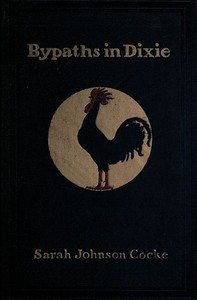
The source record for Bypaths in Dixie: Folk Tales of the South — Edition Insights measures this digital text at 44,638 words, 3 hr 15 min estimated reading time, and 5 detected text sections.
The text analysis averages about 20.7 words per sentence, while the detected sections provide another way to judge how the source is divided.
Project Gutenberg metadata also associates the work with “Short stories,” connecting these edition facts with the source record’s subject description.
Explore this collection
These alternatives are selected using recorded categories and estimated reading time.
About 192 minutes
Folklore
44,102 recorded words. 3 minutes difference from this book's estimate.
View Gutenberg source #28990About 198 minutes
Folklore
45,323 recorded words. 3 minutes difference from this book's estimate.
View Gutenberg source #46960About 204 minutes
Folklore
46,885 recorded words. 9 minutes difference from this book's estimate.
View Gutenberg source #46047Search stored excerpts and compare books → Choose by your preferences →
Choices use stored catalog measurements. Estimates vary with reading speed. A shared category is a catalog label, not a claim that two books have the same argument or literary quality.
Search reads excerpt text stored with this catalog and links to its associated Gutenberg record. The connection is stored in the site database; this tool does not recheck that every excerpt is word-for-word identical to that external record. Excerpt search does not cover every chapter and does not verify historical publication dates.
Catalog snapshot checked: 2026-09-25. Coverage: 91 public books, 91 available source excerpts.
Read the complete public-domain text at its original source.
Read on Project GutenbergSarah Johnson Cocke's Bypaths in Dixie: Folk Tales of the South (1911) opens a window into the oral storytelling traditions of the postbellum South through a distinctive narrative voice. The tales are framed as stories told by an African American nurse, Phyllis, to white children, Mary Van and Willis, a setup that immediately establishes a layered dynamic of cultural transmission. Cocke's rendering of dialect is not merely phonetic transcription but a deliberate stylistic choice that shapes rhythm, characterization, and humor. The personification of natural forces—Bob Wind, Simmon Tree, Ole Kerlum-bang Thunder—draws on African American folk motifs while also echoing the animal trickster tradition popularized by Joel Chandler Harris. Yet Cocke's tales are not imitations; they carve their own space by centering the natural world as a stage for conflict and cunning.
Cocke's use of dialect is the most immediately striking feature of the collection. Rather than a uniform transcription, she varies the density of nonstandard spellings and grammatical constructions to suggest different speakers and moods. In the excerpt, Phyllis's speech is rich with elisions and rhythmic repetitions: "Bob Win' put on his fine linnin duster an' he come er projeckin' an' frolickin' 'roun' de Reed gals." The dialect is not merely decorative; it carries the tale's momentum. Cocke also uses it to signal shifts in tone—from playful banter to tense confrontation. The children's interjections, like Willis's "And Roman candles, and sky rockets!" are in standard English, creating a clear contrast between the framed story and the framing conversation. This choice underscores the oral performance aspect: the tale belongs to Phyllis's voice, while the children's comments anchor it in a domestic, literate setting.
The tales animate natural elements with distinct personalities and social hierarchies. Bob Wind is a boastful, flirtatious figure who "crackin' his jokes" to the Reed girls, while Simmon Tree is proud and stubborn, refusing to "russ'le so much es er leaf" in response to Wind's provocations. Their conflict escalates through a series of physical confrontations—grabbing, twisting, and finally a running jump that breaks the tree. Cocke extends personification to meteorological phenomena: Ole Kerlum-bang Thunder "shoot off er few fier wurks" and Po'-Down Rain arrives to "wet dem woods mouty nigh ter flood times." This is not a static allegory but a dynamic system where natural forces interact like a rural community, complete with alliances, grudges, and contests of strength. The human-like motives—jealousy, pride, cunning—make the natural world legible as a social space.
The stories are embedded in a conversational frame: Phyllis tells them to Mary Van and Willis, who interrupt with questions and corrections. Mary Van's sharp memory—"Mammy, I thought you said Mister Man cured him"—prompts Phyllis to adjust her narrative, acknowledging the inconsistency while maintaining her authority as storyteller. This back-and-forth creates a dynamic where the tale is co-constructed, reflecting the interactive nature of oral storytelling. Cocke uses the children's interjections to clarify plot points without breaking the dialect's spell. The frame also establishes a power dynamic: Phyllis controls the story's world, while the children's standard English marks their separate, literate sphere. This layered structure allows Cocke to present folk material with a degree of self-awareness, acknowledging the tale's oral origins while adapting it for a reading audience.
Bob Wind embodies the trickster figure familiar from African American folklore: clever, boastful, and ultimately victorious through guile rather than brute strength. His victory over Simmon Tree comes not from superior force but from targeting a weak point—"de weak part" left by a childhood injury. This echoes the Uncle Remus tradition where Brer Rabbit outwits stronger adversaries. However, Cocke's trickster is not purely admirable; Bob Wind is described as "er bad lit'le boy" whose mischief nearly kills him. The moral is ambiguous: the tale celebrates cunning but also implies consequences. Phyllis's framing commentary—"he wus er starchy lookin' tree I tell yer"—adds a layer of ironic distance. The stories resist simple moralizing, instead presenting a world where survival depends on wit and adaptability, a theme rooted in the historical experiences of the African American community.
Readers approaching Bypaths in Dixie should attend to the interplay between Phyllis's oral performance and the children's literate interruptions. Cocke's dialect is not a barrier but a deliberate artistic choice that rewards careful listening. The tales are best appreciated as performances, with attention to rhythm, repetition, and the subtle shifts in register between narrator and audience. The natural world here is not a backdrop but a cast of characters with their own motives and histories. By grounding her stories in specific, observable details of language and setting, Cocke offers a valuable record of a storytelling tradition that might otherwise have been lost.
There’s something tender in how Cocke lets those old voices speak, dialect and all—like catching fragments of a song half-remembered. It made me think of At the gateways of the day — Context and Discussion, which carries a similar quiet ache for stories that slip away. I keep returning to both, the way one returns to a porch at dusk.
Use these questions to collect your thoughts before moving on.









