About 189 minutes
Favorite Fairy Tales — Themes and Context
Fairy Tales
43,257 recorded words. 1 minutes difference from this book's estimate.
View Gutenberg source #20748
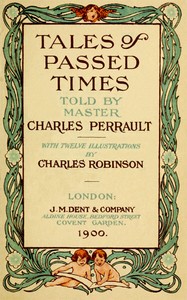
Tales of Passed Times — A Closer Reading can be approached with a clearer sense of reading commitment from its source measurements: 43,212 words, 3 hr 8 min estimated reading time, and 5 detected text sections.
The text analysis averages about 26.4 words per sentence, while the detected sections provide another way to judge how the source is divided.
Project Gutenberg metadata also associates the work with “Fairy tales,” connecting these edition facts with the source record’s subject description.
Explore this collection
These alternatives are selected using recorded categories and estimated reading time.
About 189 minutes
Fairy Tales
43,257 recorded words. 1 minutes difference from this book's estimate.
View Gutenberg source #20748About 203 minutes
Fairy Tales
46,555 recorded words. 15 minutes difference from this book's estimate.
View Gutenberg source #9368About 172 minutes
Fairy Tales
39,443 recorded words. 16 minutes difference from this book's estimate.
View Gutenberg source #31763Search stored excerpts and compare books → Choose by your preferences →
Choices use stored catalog measurements. Estimates vary with reading speed. A shared category is a catalog label, not a claim that two books have the same argument or literary quality.
Search reads excerpt text stored with this catalog and links to its associated Gutenberg record. The connection is stored in the site database; this tool does not recheck that every excerpt is word-for-word identical to that external record. Excerpt search does not cover every chapter and does not verify historical publication dates.
Catalog snapshot checked: 2026-09-25. Coverage: 91 public books, 91 available source excerpts.
Read the complete public-domain text at its original source.
Read on Project GutenbergThe three authors gathered in this volume—Charles Perrault, Jeanne-Marie Leprince de Beaumont, and Marie-Catherine d'Aulnoy—each brought distinct narrative strategies to the fairy tale. Perrault's tales, such as "The Sleeping Beauty in the Wood," open with formulaic royal settings and proceed through brisk, cause-and-effect plots. His narrators rarely pause for interiority; events unfold through external action and declarative sentences. In contrast, d'Aulnoy's "Princess Rosette" and "The Benevolent Frog" weave denser descriptive passages and more intricate magical systems, while Leprince de Beaumont's "Beauty and the Beast" foregrounds the heroine's emotional responses and moral reasoning. The collection thus becomes a study in how different authors adapted folk motifs for literate audiences.
Perrault's prose is notably economical. In "Little Red Riding-Hood," the wolf's dialogue is direct and functional: "Grandma, what great ears you have!" The narrator supplies no psychological commentary, leaving the threat to emerge from the repetition of physical details. Similarly, "Blue Beard" advances through terse commands and consequences: "Your tears are useless," said Blue Beard; "you must die." The moral verses appended to each tale—absent from the other authors' contributions—explicitly state the lesson, as in the warning against curiosity in "Blue Beard." This structural choice reflects Perrault's didactic intent, framing the stories as instructive examples for children.
In "Beauty and the Beast," the narrator frequently enters Beauty's thoughts. When she discovers a door inscribed "Beauty's Room," the text reports her inner reasoning: "He does not wish me to feel dull." Her courage is rebuilt through self-encouragement, and her dream of a lady promising reward provides moral validation. The Beast's dialogue, too, emphasizes consent: "will you allow me to look on while you are eating your supper?" This emphasis on choice and emotional growth distinguishes Leprince de Beaumont's method from Perrault's external action. The tale's length allows for sustained character development, with Beauty's reflections on the Beast's kindness gradually replacing her fear.
D'Aulnoy's tales employ more elaborate magical apparatus. In "The Benevolent Frog," a woman of gigantic size clothed in a lion's skin appears, and the narrative lingers on visual details. The frog herself is a talking animal with agency, not merely a transformed prince. D'Aulnoy's sentences are longer, with clauses that accumulate descriptive flourishes. Her worlds include multiple enchanted objects and transformations, creating a denser fairy-tale atmosphere. The editor's preface notes that her writings possess "an atmosphere of hidden magic," a quality that contrasts with Perrault's more grounded marvels. This stylistic divergence makes d'Aulnoy's contributions feel more like literary fantasies than folk-derived tales.
Charles Robinson's twelve illustrations, including the frontispiece of Cinderella, offer visual interpretations that shape reading. The image of the Sleeping Beauty in a swoon emphasizes passivity, while the wolf's oversized ears in "Little Red Riding-Hood" heighten the grotesque. Robinson's style—detailed line work with decorative borders—echoes the period's aesthetic for children's books. The illustrations are not merely decorative; they select key moments for emphasis, such as the king's son giving Cinderella his hand, or the merchant arriving just as Beauty watches in the mirror. Comparing these visual choices with the text reveals how illustrators prioritize certain narrative beats over others.
Readers attentive to authorial voice will notice how each tale's diction and pacing reflect its writer's background: Perrault's courtly concision, Leprince de Beaumont's moral psychology, and d'Aulnoy's baroque invention. The collection invites comparison not only of plots but of the very different ways these authors constructed wonder and instruction. Pay particular attention to how each tale handles the moment of transformation—whether through a prince's kiss, a beast's patience, or a frog's intervention—as these scenes crystallize each author's approach to magic and character.
That rainy afternoon, reading Perrault and d’Aulnoy side by side, I kept noticing how each storyteller’s voice pulled at the same old threads differently—the quiet pride, the unexplained kindness. Later, idly wondering whether anyone had ever sorted such tangled traditions, I stumbled into The Fairy Books of Andrew Lang A Project Gutenberg Linked Index to All Stories in the 12 Volumes — Themes and Context, and the rain seemed to soften around me.
Save your reaction, strongest insight, and memorable passage.









