
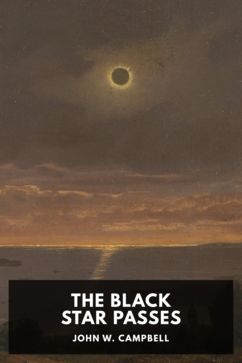
The Black Star Passes - John W. Campbell
So, you want to know what 'The Black Star Passes' is actually about? Let's break it down. It's a fix-up novel, meaning it stitches together three connected stories. First, our genius trio—Arcot, Morey, and Wade—invent the 'Molecular Motion' ship, which basically laughs at gravity. They need it, because a rogue dark star is barreling toward us, ready to yank Earth into the cold void. Their solution is as brilliant as it is desperate.
The Story
The plot kicks into high gear when they chase the black star's effects to Venus. There, they don't find little green men. They find the ruins of a mighty, long-dead civilization and clues pointing to a war with an even more advanced enemy. This discovery launches them on an interstellar detective mission. The middle section is a pure puzzle-box: who were these people, and what killed them? The final act is a full-scale space opera conflict, as our heroes face the descendants of that ancient enemy. It's a chain reaction: solve a solar system crisis, uncover a galactic mystery, then fight to prevent history from repeating.
Why You Should Read It
This book is a blast from sci-fi's past, and that's its charm. Campbell isn't writing about feelings; he's writing about ideas. The thrill here is in the 'how.' How do we stop a star? How does this machine work? The characters are vessels for ingenuity—they're the guys you want on your team when the universe throws a logic problem at you. Reading it, you feel that raw, optimistic pulse of early 20th-century science fiction, where every equation held the promise of a new frontier. It's less about deep character arcs and more about the sheer joy of solving the universe's biggest problems with a slide rule and a bold idea.
Final Verdict
This one's for the classic sci-fi fan and the curious newcomer. If you love Asimov's Foundation or any story where intellect is the ultimate weapon, you'll see where that tradition got its start. It's also perfect for anyone tired of dystopias and craving some unapologetic, problem-solving optimism. The science is dated (in a fun, retro way), and the dialogue can be clunky, but the sense of adventure is timeless. Think of it as a foundational text, a thrilling blueprint for the smart, idea-driven science fiction that followed.
This digital edition is based on a public domain text. It is now common property for all to enjoy.
Joshua Ramirez
1 year agoWow.
Kenneth Taylor
7 months agoGreat reference material for my coursework.
Donna Perez
5 months agoAfter finishing this book, the arguments are well-supported by credible references. I learned so much from this.
Paul Brown
10 months agoI had low expectations initially, however it challenges the reader's perspective in an intellectual way. Truly inspiring.




Mark Martin
2 months agoThanks for the recommendation.