About 30 minutes
The nightingale — Reading Notes
Fairy Tales
6,870 recorded words. 0 minutes difference from this book's estimate.
View Gutenberg source #71096
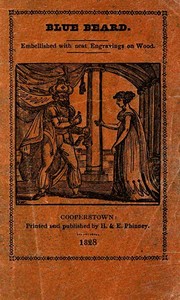
For The Popular Story of Blue Beard — Story, Setting & Ideas, the stored edition analysis reports 6,886 words, 30 min estimated reading time, and 1 detected text section.
The text analysis averages about 27.3 words per sentence, while the detected sections provide another way to judge how the source is divided.
Project Gutenberg metadata also associates the work with “Fairy tales,” connecting these edition facts with the source record’s subject description.
Explore this collection
These alternatives are selected using recorded categories and estimated reading time.
About 30 minutes
Fairy Tales
6,870 recorded words. 0 minutes difference from this book's estimate.
View Gutenberg source #71096About 28 minutes
Fairy Tales
6,404 recorded words. 2 minutes difference from this book's estimate.
View Gutenberg source #30580About 19 minutes
Fairy Tales
4,294 recorded words. 11 minutes difference from this book's estimate.
View Gutenberg source #30020Search stored excerpts and compare books → Choose by your preferences →
Choices use stored catalog measurements. Estimates vary with reading speed. A shared category is a catalog label, not a claim that two books have the same argument or literary quality.
Search reads excerpt text stored with this catalog and links to its associated Gutenberg record. The connection is stored in the site database; this tool does not recheck that every excerpt is word-for-word identical to that external record. Excerpt search does not cover every chapter and does not verify historical publication dates.
Catalog snapshot checked: 2026-09-25. Coverage: 91 public books, 91 available source excerpts.
Read the complete public-domain text at its original source.
Read on Project GutenbergThis 1828 Cooperstown edition of Charles Perrault's "Blue Beard" opens with a frontispiece captioned "While Fatima is kneeling to Blue Beard, and supplicating for mercy, he seizes her by the hair, and raises his scymetar to cut off her head." The image immediately establishes the climactic moment of peril. Following the title page, an alphabet and typographic specimen page appears, listing letters, ligatures, and punctuation marks—a feature common in early American children's books that served both instructional and decorative purposes. The narrative then begins with a lengthy description of the gentleman's wealth: his "magnificent castle" on a "rising ground," rooms hung with "the richest damask," and carriages that "might have served a king." This emphasis on material splendor sets the stage for a story where curiosity about forbidden spaces drives the plot.
The tale follows a clear three-part structure: the introduction of Blue Beard and his courtship, the violation of the forbidden closet and its discovery, and the rescue and resolution. The narrative moves deliberately from domestic description to suspense. The key turning point occurs when Fatima receives the keys and is told she may open every room except the closet. The warning is explicit: "if you open that closet, you must expect nothing less than my severest anger." This direct threat contrasts with the otherwise polite tone of the gentleman's speech. The structure builds tension through Fatima's internal struggle, her eventual disobedience, and the immediate consequence of dropping the key in blood. The pacing accelerates after the discovery, with Blue Beard's return and ultimatum compressed into a few paragraphs.
Wealth is described in meticulous detail: "dishes and plates were either of silver or gold," chairs covered with "the finest velvet, fringed with gold." These images of luxury recur throughout, contrasting sharply with the violence. The forbidden closet contains "the dead bodies of several ladies" with "their throats cut from ear to ear." The blood-stained key is a recurring object—Fatima tries to wash it, but it remains stained because "the key was a fairy key, and could not be cleaned." This magical element introduces a supernatural consequence. The scymetar (scimitar) appears twice: in the frontispiece and in the final scene where Blue Beard raises it. The repetition of these violent objects anchors the moral warning about curiosity.
The story moves between distinct locations: the castle's exterior ("rising ground," "groves of the finest evergreens"), its opulent interior rooms, the forbidden closet, and the tower where Anne watches for help. Fatima's journey from the closet to the tower is described with urgency: she calls to her sister Anne to "go up to the top of the battlements, and see if my brothers are coming." Anne's repeated reports—"I see nothing but the sun, which makes a dust, and the grass, which looks green"—create a rhythmic delay. The final movement is the brothers' arrival, their rush into the apartment, and the pursuit of Blue Beard "before he had got above twenty paces from the place." These spatial shifts reinforce the contrast between confinement and rescue.
After Blue Beard's death, the narrative shifts to a detailed account of Fatima's inheritance and her prudent management. She becomes "sole heir to the whole of his immense property" and is "confirmed by the laws of the country." The closet is repaired to "remove every trace of his barbarity." Fatima then gives a "magnificent entertainment" and distributes wealth to her brothers, sister, and the poor. The story ends with her marriage to a young nobleman. This conclusion emphasizes the restoration of social and domestic order, rewarding Fatima's eventual obedience and virtue. The moral is implicit: curiosity leads to danger, but proper conduct and family loyalty restore harmony. The final paragraph notes that the bodies of the murdered ladies are buried privately, and the fatal closet is repaired, erasing the evidence of violence.
Readers may note how this edition's typographic front matter—the alphabet page and the engraved frontispiece—frames the story as both a moral lesson and a reading exercise. The narrative's clear division into scenes of temptation, discovery, and rescue makes it suitable for oral reading. Pay attention to the repeated use of the key as a symbol of guilt and the way the setting shifts from lavish interiors to the exposed battlements, emphasizing the contrast between safety and danger.
Blue Beard’s Cooperstown edition, with its stiff alphabet and tidy moral, still lets a shiver through. I often think of it beside The Tales of Mother Goose As First Collected by Charles Perrault in 1696 — Background and Themes—both have that patient, candlelit way of tidying shadows into a lesson, never quite hiding the key’s dark glint. Such old friends, these.
A brief reflection can help important ideas stay with you longer.









