About 534 minutes
Myths & Legends of Babylonia & Assyria — Themes and Context
Myths Legends
122,733 recorded words. 47 minutes difference from this book's estimate.
View Gutenberg source #45137
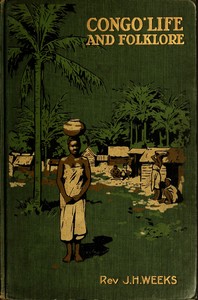
The source record for Congo life and folklore — Context and Discussion measures this digital text at 111,814 words, 8 hr 7 min estimated reading time, and 19 detected text sections.
The text analysis averages about 26.3 words per sentence, while the detected sections provide another way to judge how the source is divided.
Project Gutenberg metadata also associates the work with “Congo (Democratic Republic),” connecting these edition facts with the source record’s subject description.
Explore this collection
These alternatives are selected using recorded categories and estimated reading time.
About 534 minutes
Myths Legends
122,733 recorded words. 47 minutes difference from this book's estimate.
View Gutenberg source #45137About 559 minutes
Myths Legends
128,347 recorded words. 72 minutes difference from this book's estimate.
View Gutenberg source #45723About 394 minutes
Myths Legends
90,396 recorded words. 93 minutes difference from this book's estimate.
View Gutenberg source #71656Search stored excerpts and compare books → Choose by your preferences →
Choices use stored catalog measurements. Estimates vary with reading speed. A shared category is a catalog label, not a claim that two books have the same argument or literary quality.
Search reads excerpt text stored with this catalog and links to its associated Gutenberg record. The connection is stored in the site database; this tool does not recheck that every excerpt is word-for-word identical to that external record. Excerpt search does not cover every chapter and does not verify historical publication dates.
Catalog snapshot checked: 2026-09-25. Coverage: 91 public books, 91 available source excerpts.
Read the complete public-domain text at its original source.
Read on Project GutenbergThe book opens with an unusual narrator: a brass rod, the currency of the Congo region. This device immediately signals Weeks's interest in material culture and economic exchange. The rod describes its own use in trade, ornament, and daily life, noting that a single necklet could weigh twenty-eight pounds and a woman's leg rings nearly sixty. This concrete detail grounds the reader in a world where value is measured in weight and length, not coinage.
Weeks, a Baptist missionary, spent years among the people of the Lower and Upper Congo. The book is divided into two parts: a first-person account of life and trade, and a collection of thirty-three stories told around evening fires. The preface explains that the brass rod narrative is a device to weave together his anthropological notes, but the voice remains that of an observer who is also a participant in the exchanges he describes.
The excerpts reveal a meticulous system of barter. Every item in a white trader's store had a price in cloth equivalents: six knives equaled one piece of cloth, eight looking-glasses the same. The first cloth was worth about two shillings for twelve yards, and later goods were rated against this standard. Natives quickly learned which traders offered fair prices and avoided those who overcharged. Weeks records a ten-day haggling session to sell rubber, peanuts, and ivory, during which the party often went hungry because coastal food was dear.
One transaction shows the cultural gap: Satu's agent, given fifteen extra pieces, selected cloth, gunpowder, beads, mugs, rum, and gin. The sale of peanuts was simpler—weight for weight in salt, with a gaudy plate thrown on top. These details illustrate a world where value was negotiated face-to-face, and where a broken china ornament could be accepted without blame, as when Old Plaited-Beard's carrier slipped on boulders and smashed the fragile goods.
Weeks does not hide his role. He is both a missionary and a participant in trade, living in a shed while transacting business. He notes that some native traders suspected the interpreter was taking too much, and went to other white men. The narrative voice is that of a careful note-taker: 'For a considerable time the writer has been interested in the folklore and anthropology of the people, and has made long and careful notes.' Yet the excerpts show that his observations are filtered through the lens of trade and mission work.
The dedication to colleagues 'whose arduous labours and faithful lives have redounded to the glory of Christ' makes the book's purpose clear. But the ethnographic detail often overshadows the religious frame. The brass rod narrator allows Weeks to describe customs without moralizing, though the underlying hierarchy of 'white trader and native traders' remains visible. The tension between observer and participant is never fully resolved.
The second part of the book contains thirty-three native stories, presented as told by Congolese storytellers. The excerpts do not include the stories themselves, but the title and structure suggest they are meant to complement the ethnographic first half. Weeks's preface indicates he has worked his notes into the brass rod narrative, implying that the stories are also edited for a European audience.
The phrase 'as told round the evening fires' evokes a communal setting, but the reader cannot know how much the tales have been adapted. The book's subtitle promises folklore, and the catalog lists 'Folklore -- Congo (Democratic Republic)' as a subject. However, without the full text, one can only note that the stories are presented as authentic, while the framing device of the brass rod reminds us that all cultural exchange involves translation and negotiation.
Readers should approach this book as a document of its time—a missionary's attempt to record a culture through the lens of trade and storytelling. The brass rod narrator is a clever conceit, but it also reveals the limits of the author's perspective. The folktales, if read alongside the ethnographic sections, may offer glimpses of Congolese voices, though filtered through Weeks's editing. For those interested in early colonial encounters, the book provides a detailed, if partial, view of life on the Congo River in the early 1900s.
I have held many books across the years, but Congo Life and Folklore stays with me—those brass rods clicking through tales, a quiet rhythm of exchange. It made me think of a certain Myths & Legends of Japan — Key Ideas to Explore, where spirits also speak through ordinary objects. Both whisper that the world is more alive than we admit.
Capture what you thought, learned, and would like to remember.