About 608 minutes
The magic of jewels and charms — A Closer Reading
Fantasy Classics
139,699 recorded words. 467 minutes difference from this book's estimate.
View Gutenberg source #66583
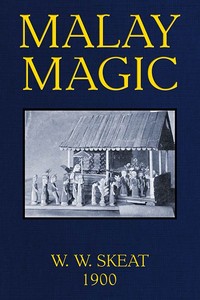
The catalog record for Malay Magic Being an introduction to the folklore and popular religion of the Malay Peninsula — Inside the Classic provides practical reading context through 247,043 words, 17 hr 55 min estimated reading time, and 275 detected text sections.
The text analysis averages about 25.1 words per sentence, while the detected sections provide another way to judge how the source is divided.
Project Gutenberg metadata also associates the work with “Magic -- Malay Peninsula,” connecting these edition facts with the source record’s subject description.
Explore this collection
These alternatives are selected using recorded categories and estimated reading time.
About 608 minutes
Fantasy Classics
139,699 recorded words. 467 minutes difference from this book's estimate.
View Gutenberg source #66583About 355 minutes
Fantasy Classics
81,490 recorded words. 720 minutes difference from this book's estimate.
View Gutenberg source #2400About 226 minutes
Fantasy Classics
51,897 recorded words. 849 minutes difference from this book's estimate.
View Gutenberg source #37245Search stored excerpts and compare books → Choose by your preferences →
Choices use stored catalog measurements. Estimates vary with reading speed. A shared category is a catalog label, not a claim that two books have the same argument or literary quality.
Search reads excerpt text stored with this catalog and links to its associated Gutenberg record. The connection is stored in the site database; this tool does not recheck that every excerpt is word-for-word identical to that external record. Excerpt search does not cover every chapter and does not verify historical publication dates.
Catalog snapshot checked: 2026-09-25. Coverage: 91 public books, 91 available source excerpts.
Read the complete public-domain text at its original source.
Read on Project GutenbergWalter William Skeat's Malay Magic opens not with a thesis but with a procession of ritual objects: the bridegroom's head-dress of red cloth arranged turbanwise, the bride's forehead bound with a tinsel fillet called tĕkan kundei, and the sĕtakona—an octagonal framework filled with saffron rice and planted with coloured eggs. These are not mere curiosities; they are the book's primary evidence. Skeat, a British civil servant in Selangor, compiles his material from native manuscripts, published sources, and his own observations, arranging it by the life-cycle and the calendar rather than by theme. The result is a work that moves from birth rituals to funeral rites, from rice-farming charms to royal regalia, treating each practice as a fact of equal weight.
Skeat structures his chapters to mirror the order of performance. The wedding ceremony, for instance, is broken into named days: the "Concluding Day" (Hari Langsong) is described after the preliminary rites, and each garment, gesture, and offering appears in the sequence a participant would encounter it. This chronological arrangement lets the reader follow the logic of the ritual without imposing an external analytical framework. The same method governs the treatment of rice cultivation, where the stages from sowing to harvest are given their own spells and prohibitions. Skeat rarely steps back to generalize; he lets the sequence speak for itself.
The text lingers on the physical composition of objects. A bride's jacket is made of "flowered satin" or cloth dyed red with kasumba; the groom's head-dress is stuffed with cotton-wool to hold its shape. These details are not decorative—they are the data. Skeat records the metals in a bride's anklets (panchalogam, five metals) and the number of gold buttons on a jacket. He notes that former Sultans of Selangor wore a gold cap said to contain eighteen bongkal of gold. By specifying materials and quantities, he turns each object into a document of social rank and regional practice.
The excerpts show a constant traffic between the human and the spirit realm. Charms are recited to protect rice fields, to summon rain, to ward off disease. Skeat records the words of these spells alongside the actions that accompany them—the cutting of a branch, the placing of an egg. He does not judge the efficacy of these practices; he treats them as observable behaviour. The preface, written by Charles Otto Blagden, defends this approach by arguing that "a belief which is actually held" is a fact. Skeat's method is to document the movement between the visible and the invisible as if it were any other kind of motion.
Skeat rarely appears in the first person, but his presence is felt in the precision of his descriptions. He notes that the wedding jacket "fits tightly round the neck" and that the bride's hair is "done up in a roll (sanggul)". These observations come from someone who has watched closely, possibly during the ceremonies themselves. Yet the book is not a memoir; it is a compilation. Skeat draws on "unpublished native manuscripts" and the work of earlier writers, weaving them into a single account. The reader is left to infer which details come from which source. The effect is that of a catalogue assembled by a careful hand, not a narrative shaped by a single voice.
Skeat's Malay Magic is best read as a field notebook expanded into a reference work. Its strength lies in its refusal to smooth over contradictions or to explain away what it cannot interpret. Readers interested in the texture of daily ritual—the feel of a head-dress, the weight of a gold button—will find it here, arranged not by argument but by occasion. The book rewards those who move through it slowly, following the sequence of a ceremony from start to finish, as Skeat himself must have done.
There’s a particular tenderness in old books like Skeat’s Malay Magic, where every charm and ritual feels like a hand reaching across time. It reminds me of evenings spent with my grandfather, who told stories the same way—slowly, as if savoring each word. That wistfulness returned when I came across Puss in Boots, Jr., and the Good Gray Horse — Key Ideas to Explore, a quieter kind of magic, but magic all the same.
A brief reflection can help important ideas stay with you longer.